
How AI is expanding the reach of Business Intelligence
Digital and AI are becoming standard in every strategy, and BI is one of the places where that shift is already paying off: more efficient work, and sharper visibility into what is actually happening in the business.
AI is expanding the reach of Business Intelligence by changing the economics of what can be built, who can use it, what questions can be answered, and how quickly intelligence can reach the business. It is making entirely new categories of analytical products economically viable — from conversational interfaces and on-demand analysis to highly tailored experiences that would previously have been too resource-intensive to build. In practice, this changes the analytical products we can create, the teams we can reach, and the speed at which answers can reach the business.
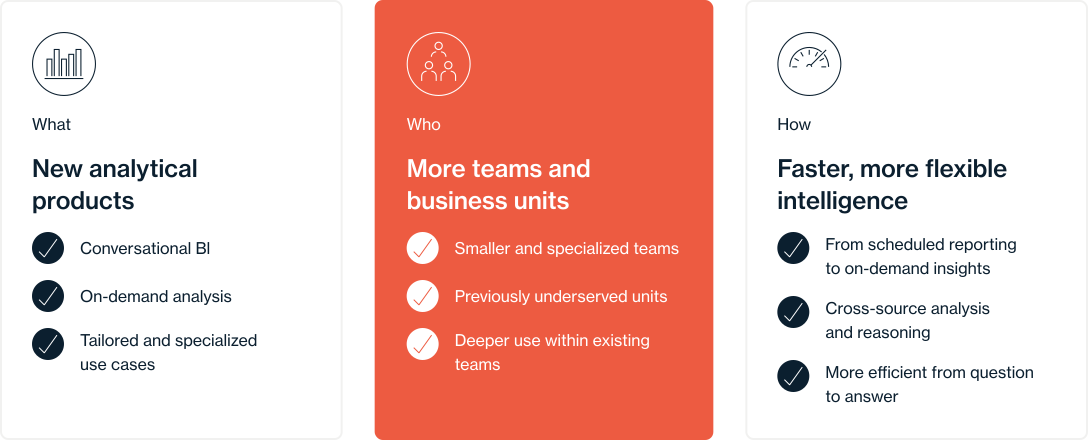
What now clears the threshold
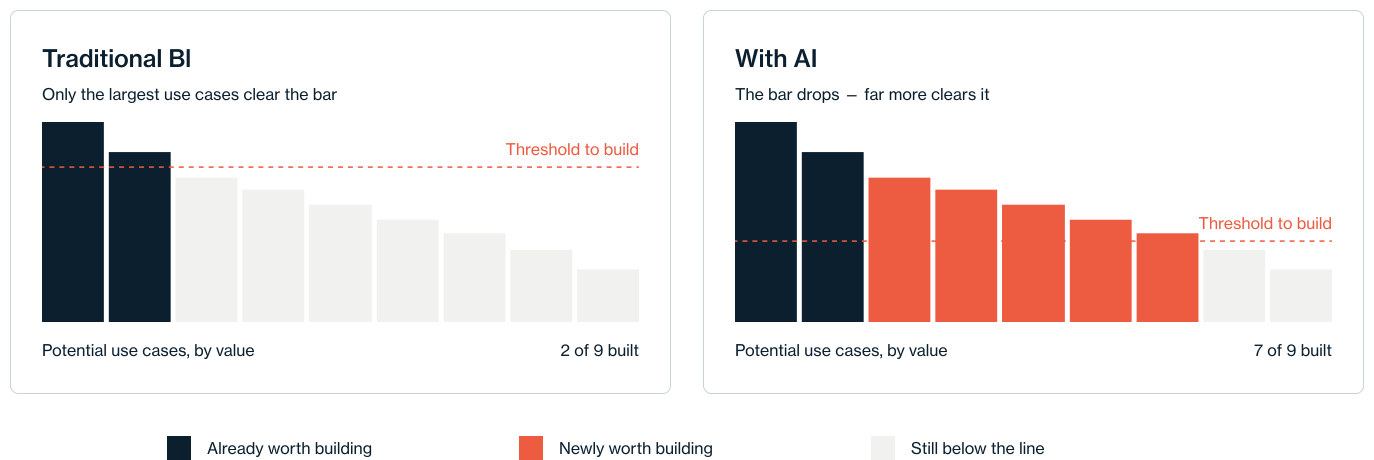
Traditional BI had an implicit economic threshold. If a use case required several weeks of development, a dedicated dashboard, data engineering, UX and design work, ongoing maintenance, and continued support, many potentially valuable use cases simply never crossed that threshold — the value was real, but the business case never quite closed.
AI lowers that threshold through efficiency and automation, increasing productivity at every stage of a build.
Efficiency
Data preparation, modelling, and dashboard design — the work that used to dominate a build — are now largely assisted rather than done by hand. Even using the AI has become more efficient, since the assistant can work directly with the actual data model rather than a description of it.
Automation
Documentation, data quality checks, and rule-driven executive summaries are now generated automatically rather than produced manually. Even working with the AI has become more automated: once a workflow is captured as a reusable skill, the AI follows it without new instructions.
The result: a use case no longer needs to justify a full development effort to be worth building.
Efficiency and automation in practice
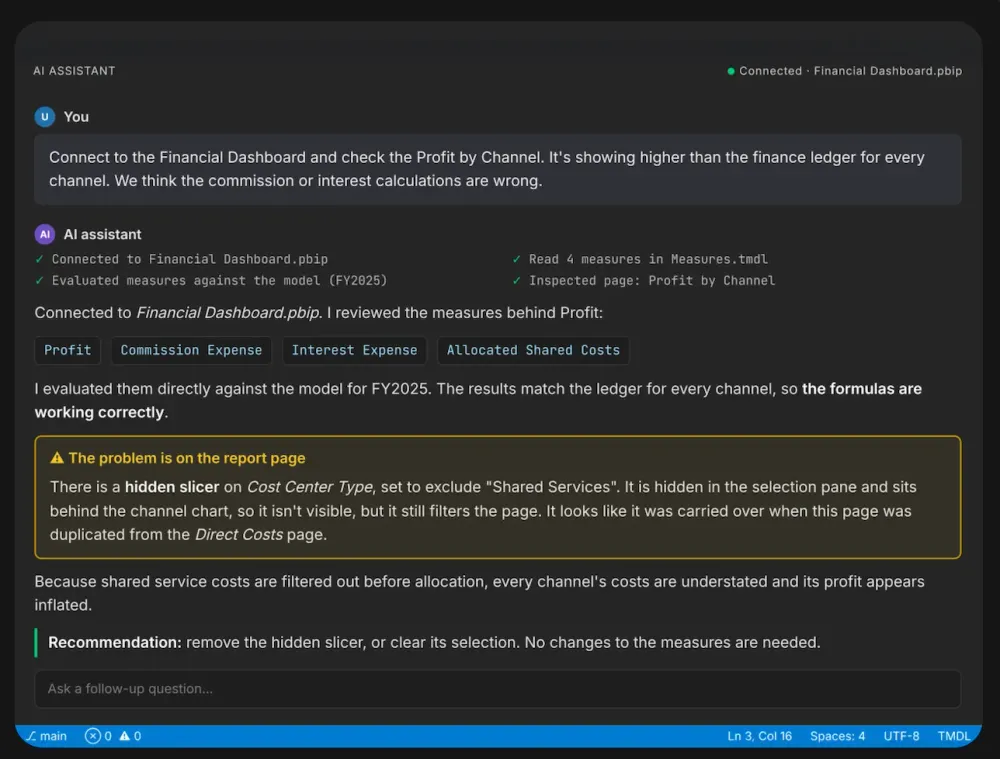
Building and reviewing the data model is more efficient with AI. Connecting AI to the governed semantic model is now a standard part of how we build, giving us a more efficient way to interrogate relationships, dependencies, and business logic as the model takes shape. It surfaces issues earlier and produces documentation along the way. On one project, for instance, it pinpointed the cause of an incorrect result: not the formulas or relationships the team was examining, but a hidden filter on the page, quietly distorting the numbers.
Consolidating scattered logic into a single, shared source is also more efficient with AI. Without it, turning the knowledge accumulated across many individual requests into a consistent set of queries and a coherent model was a project few could prioritize. On one engagement, we did exactly that: AI translated those business definitions into the queries behind a central customer data hub and helped us structure its data model. The hub now serves dashboards, recurring analysis, and ad hoc questions alike, so there is no need to rebuild the same logic for each new need.
Executive summaries are generated automatically with AI. In a loyalty program, we asked AI to create a set of rules comparing performance across periods and membership tiers, and to apply them automatically as a rule-driven executive summary. One of those comparisons flagged a small tier carrying a disproportionate share of spend relative to its size, a business-relevant read that could inform how the reward budget for that tier should be sized.
The point is not just the outputs themselves: none of this required a standalone development effort or an analyst manually producing it, so the backlog kept moving.
New products become viable
Lowering the threshold changes what we can build. Entire product categories become worth building, not just improved versions of what already existed.
Take conversational BI. Instead of asking a business user to navigate multiple dashboards, filter by the right dimensions, and piece together their own answer, we can give them an interface where they interrogate their business directly and get a reasoned answer back.
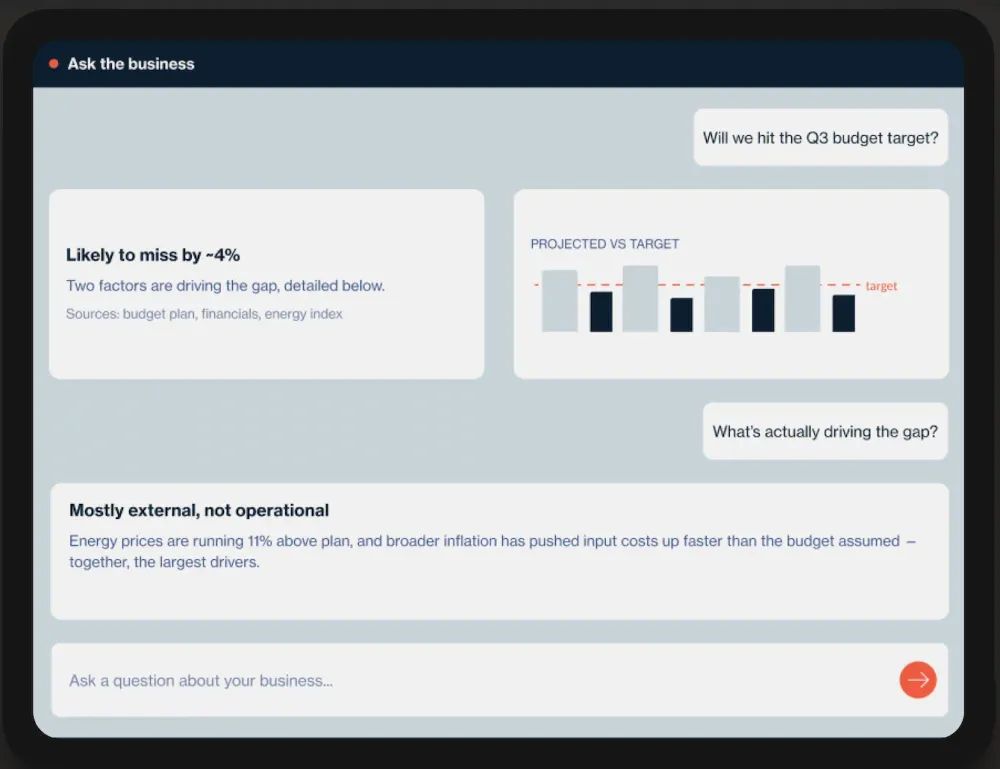
On one engagement, we built a conversational tool that could answer not just whether a budget target would be met, but why it would not — reasoning across internal financial data, planning documents, and external factors like energy prices that the budget itself never accounted for.
That shift, from scheduled to on-demand, matters as much as the individual product does. Historically, deep analysis only happened on a cadence — the monthly report, the quarterly review — because producing it took more effort than a more frequent rhythm could sustain. Once that effort drops, so does the reason to wait: a question can be asked and answered the moment it comes up, with the same rigor.
That is not an enhanced dashboard. It is a different product.
New teams and business units become reachable
The shift in BI economics also changes who we can serve directly. The same logic that makes a narrow question worth answering also makes a smaller business unit worth a dedicated build: one that was already part of the business, with real problems worth looking into, but where building something custom for it previously took more attention than the team could justify.
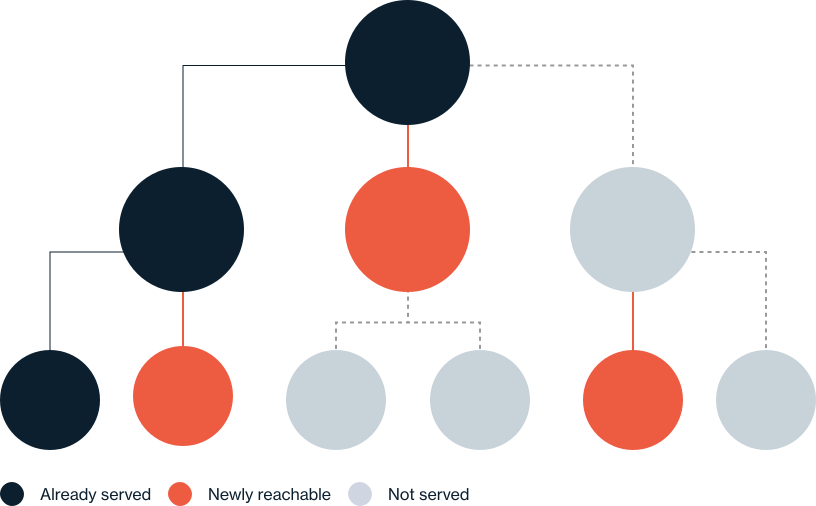
Much of this comes from a new kind of deliverable. Alongside traditional BI platforms, AI now lets us create standalone dashboards from a plain description of what the business needs, without a conventional development cycle. On a single engagement, that extended our reach in three fronts.
Beyond project delivery
A department outside our project scope ended up with a risk-decisioning dashboard tracking approval rates, queue times, and processing performance. Built as a standalone deliverable rather than a traditional platform build, it served a team that was never going to make anyone's roadmap.
Key stakeholders
For senior stakeholders, we created a dashboard showing our roadmap for the coming weeks and months. It runs from a simple spreadsheet file, so keeping it current takes minimal effort.
End-to-end
To bring these together, we built a dashboard hub that gives teams a single entry point to ad hoc analyses, traditional platform dashboards, and standalone ones, all approved by IT and protected by access control.
This is not only about scale: it is about reaching teams and key stakeholders that were not previously viable targets for a dedicated BI build at all.
What this means for BI
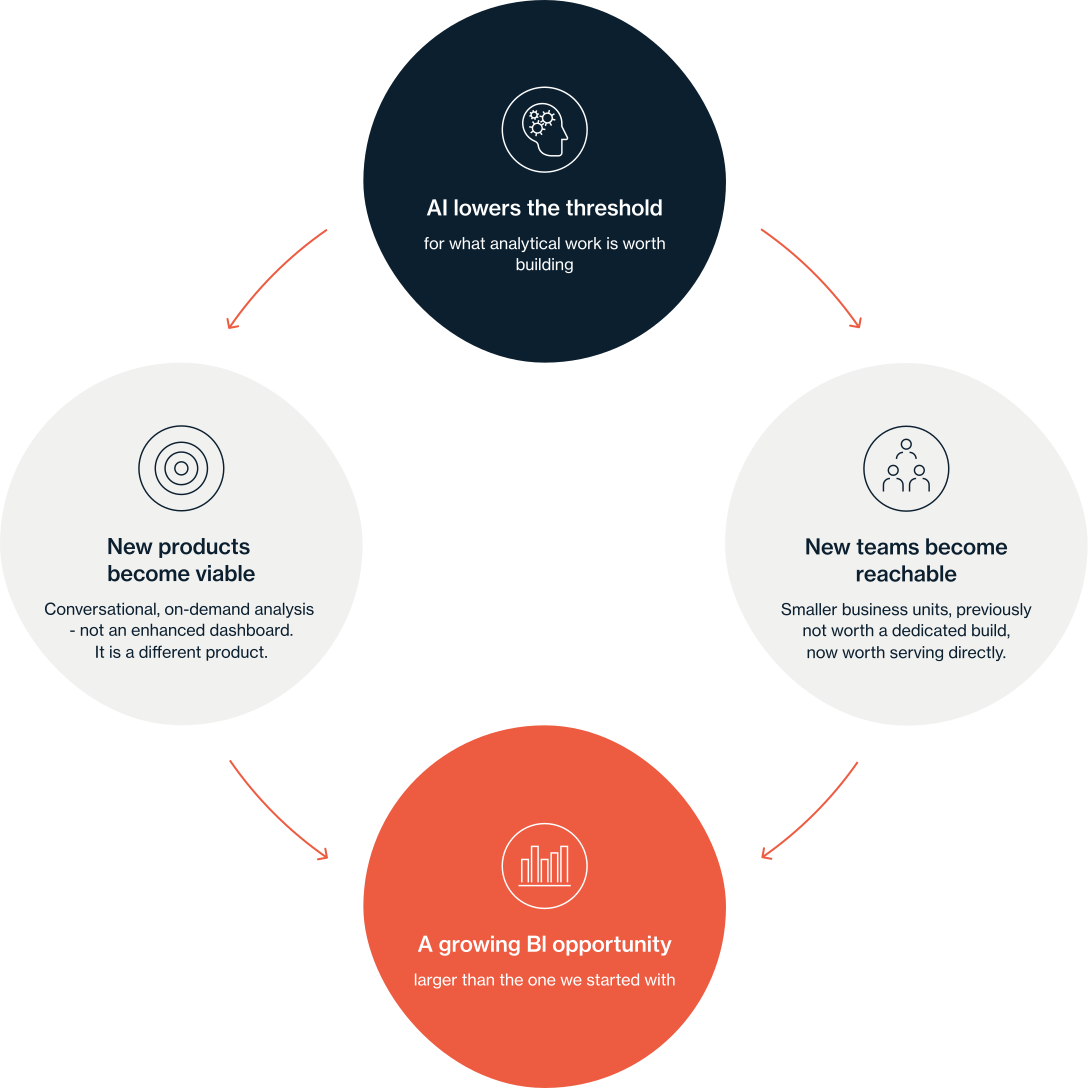
AI is changing the economics of BI. Through efficiency and automation, it lowers the threshold for what is worth building, and that single shift changes both what we can build, like conversational BI, and who we can serve directly.
Together, that is a virtuous cycle. Each new build leaves behind reusable foundations, such as shared data, documented models, and proven logic, that make the next use case easier to justify. More questions become worth answering, more products become worth building, and BI reaches more teams and key stakeholders across the business. With a blend of BI and AI expertise, we are already delivering new products and reaching new teams. This is where we lead.
Julio Alonso-Rodriguez is a Partner; Arpit Gupta is a Data Science Director based in Madrid; and Jovelson Aguilar is a BI Associate based in Porto — all contributing their perspective from client engagements across BI and data projects.