Why CRM has become such a critical growth lever for direct-to-consumer businesses

The most commercially resilient direct-to-consumer (D2C) businesses are responding to rising ad rates, more expensive customer acquisition, and less predictable growth by unlocking the value in their existing customer base. Our team explores why CRM has become such a critical growth lever for D2C businesses and what it actually takes to build one that delivers.
For most of the past decade, the dominant logic of commercial growth was built on acquisition such as investing in paid channels, driving traffic, and converting at scale. That predictability is now eroding, and the pressures driving that erosion are not cyclical. They are structural, converging simultaneously, and forcing a fundamental reassessment of where sustainable growth actually comes from.

Digital advertising spend has grown consistently throughout the years with cost-per-click increasing by 60% across social channels and 52% across search and SEA over the same period, based on internal Metyis benchmark data (Graphic 1). Businesses are spending significantly more to acquire each customer while returns on that investment continue to decline.
At the same time, brand-owned eCommerce is losing ground to marketplaces at a pace that is no longer marginal while marketplaces are projected to represent approximately 63% of European digital retail by 2028, growing at 8% CAGR compared to near-flat growth of 1% for brand.com (Graphic 2). Even the traffic brands that manage to acquire are converting with less engagement: visit duration among customers is declining year on year, signaling that the relationship between brands and their digital audiences is weakening at precisely the moment when paid acquisition is hardest to justify on returns alone.
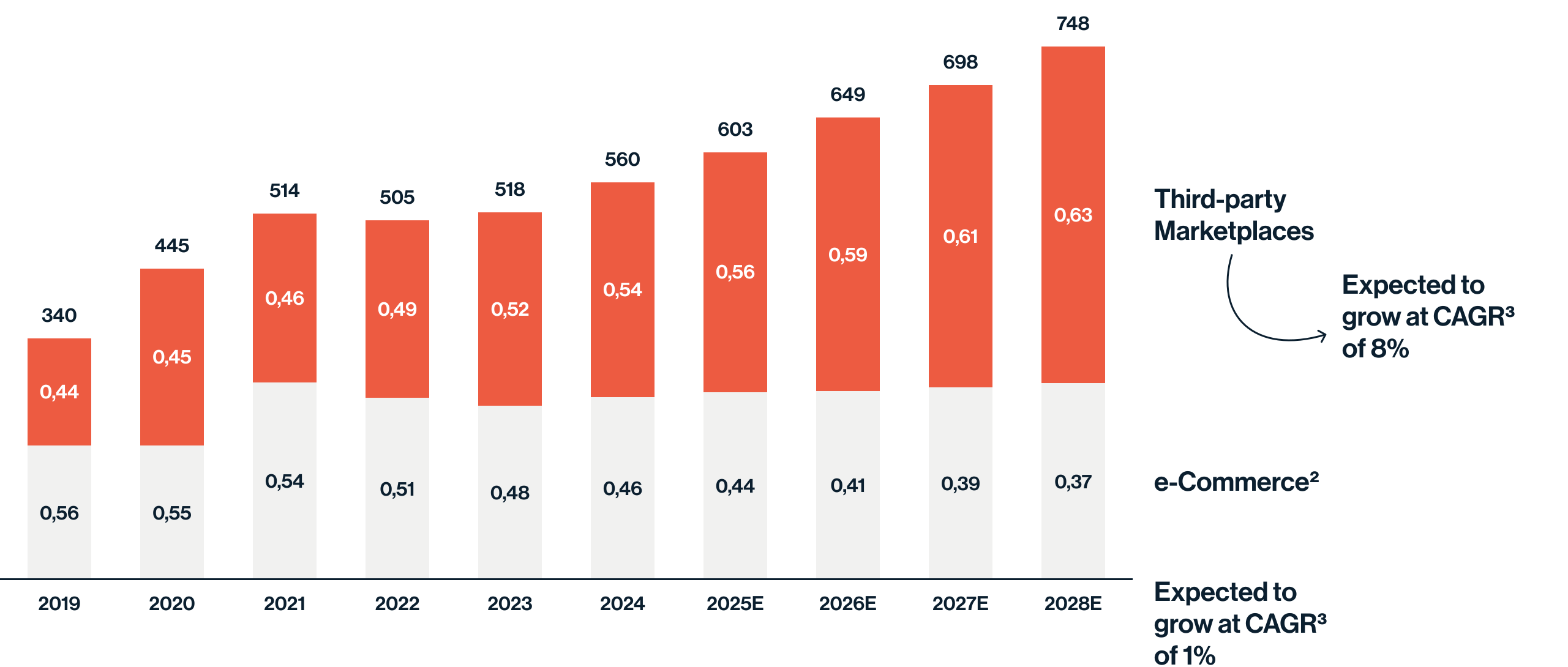
The strategic implication is not that paid acquisition or brand.com no longer matter. It is that neither can carry the commercial weight that has historically been placed on them. Businesses that continue to depend on paid channels to drive growth will find margins compressing and predictability declining in equal measure. The organisations navigating this environment most effectively are treating their existing customer base not as a retention challenge but as a revenue asset and deploying CRM as the system that unlocks it.
The unrealised potential of CRM
For most direct-to-consumer businesses, CRM remains one of the most consistently underutilised commercial capabilities available to them. It functions primarily as a messaging tool — a channel for newsletters, promotional emails, and lifecycle nudges driven more by campaign calendars than by customer behaviour. The opportunity to use that same customer data as a predictive, commercially intelligent asset remains largely unrealised.
The failure modes are consistent across businesses of all sizes. Customer data is fragmented across channels, journeys are generic or inconsistent, segmentation is shallow, and the ability to anticipate churn or identify the next best offer before the moment has passed is limited. Personalisation, when it exists at all, tends to be surface-level, applied to creative rather than rooted in behavioural intelligence. The underlying problem is the same in almost every case: CRM has been configured around operational convenience rather than commercial outcome. When paid acquisition was more reliable and marketplace competition moderate, that was an inefficiency businesses could absorb. Today, with acquisition costs rising and marketplace share compounding, it has become a structural liability.
The CRM opportunity across the entire value chain
Based on our industry expertise, CRM unlocks tangible financial impact across the entire value chain: top line revenue, cost-to-serve and working capital.
1. Top-line growth
Properly orchestrated lifecycle programmes (retention, conversion optimisation, up- and cross-sell) consistently produce revenue uplifts of between 3% and 9% across our client base.
2. Operational efficiency
AI-supported CRM workflows reduce the cost of running CRM programmes by 20% to 30%, primarily through automating routine tasks and reducing manual campaign effort.
3. Working capital optimisation
Predictive CRM models applied to demand forecasting and inventory management improve forecasting accuracy by approximately 20%, directly reducing out-of-stock events and excess end-of-season inventory.
The CRM Value framework: three pillars working as one system
The outcomes above do not follow from technology investment alone. They are the result of an integrated, end-to-end approach enabled by data, technology, automation, and AI operating together as a unified commercial capability. This is the architecture that underpins our CRM Value Framework, which operates across three pillars.
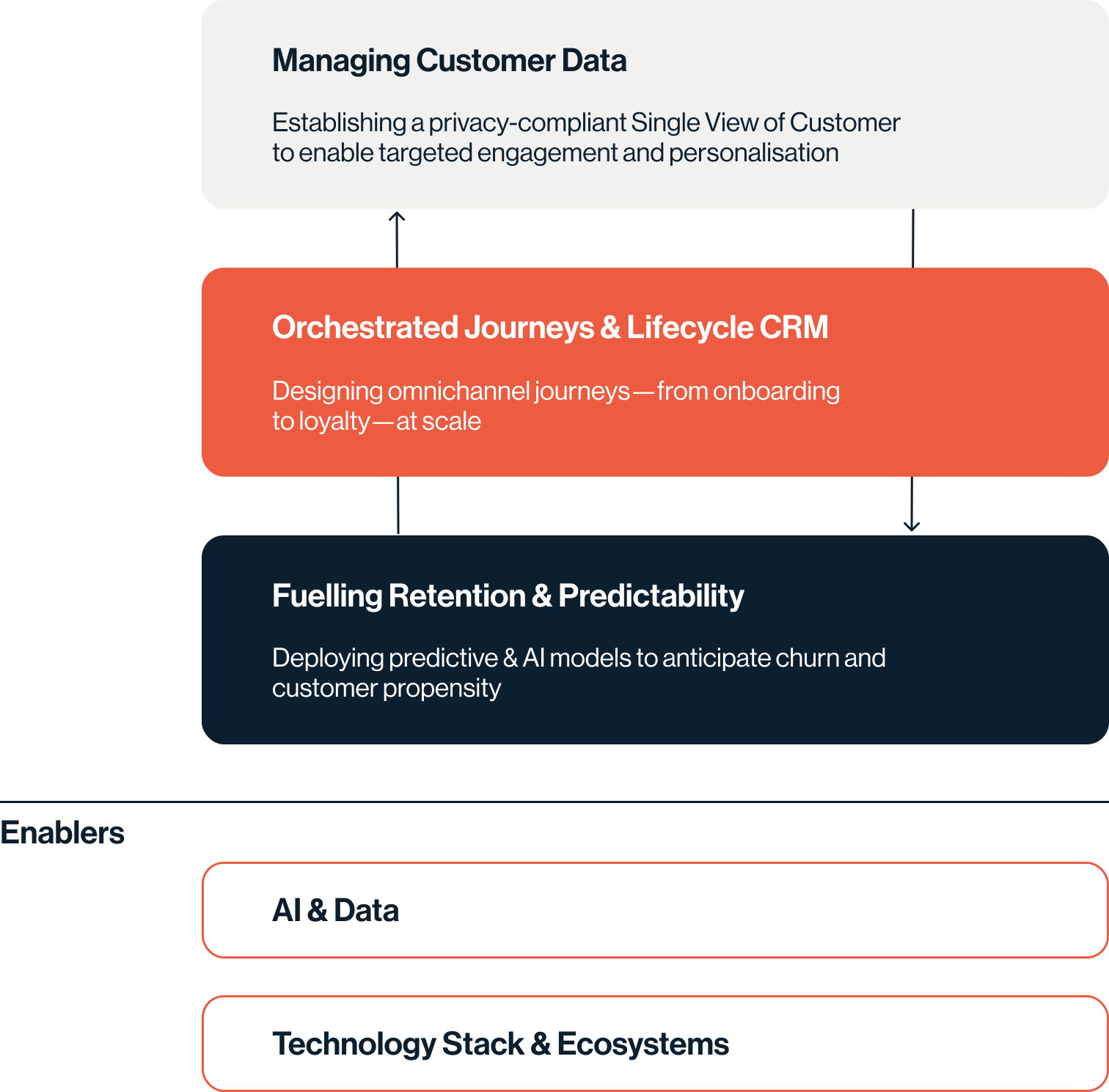
1. Managing customer data
The first pillar demands deliberate data quality standards and consent management as ongoing disciplines. This is the basis of a reliable, unified customer view to avoid imprecise segmentation, disconnected journeys, and low-quality predictive models. This solid data governance foundation is established through:
- Data capture, hygiene, and compliance: consistent data collection standards and quality governance across all customer touchpoints
- A Unified Data Layer and CDP: bringing together data from CRM, web and app behaviour, sales, customer support, and billing into a single accessible environment
- A Single View of Customer (SVoC): a privacy-compliant, consolidated customer profile that can be activated across marketing, sales, and service functions
- Segmentation and audience building: base segmentation and customer lifetime value tiers that make targeting precise and commercially meaningful
2. Orchestrating journeys and lifecycle CRM
The second pillar translates customer understanding into sustained commercial action across the full customer life cycle. This covers:
- Customer journey and touchpoint mapping: understanding where customers are in their relationship with the businesses and what they need at each stage
- Lifecycle programmes and automation: omnichannel journeys from onboarding through to loyalty, triggered by customer behaviour rather than campaign calendars
- Revenue-driving channel activation: coordinated performance across email, SMS, and push as part of a unified strategy rather than isolated sends
- Persona-based personalisation: journeys that reflect individual customer profiles and preferences rather than broad segment assumptions
- AI-supported content optimisation: continuous refinement of messaging, timing, and offer based on what is actually converting
3. Fuelling retention and predictability
The third pillar is where CRM shifts from reactive to genuinely predictive and with a compouding comercial value as models improve and customer data deepens. This covers:
- Predictive modelling: customer lifetime value and churn propensity models that identify at-risk segments before disengagement becomes visible in behaviour
- Value-based management: RFM modelling to prioritise high-value customer tiers and protect the most commercially important segments through targeted intervention
- Next Best Action (NBA): AI-led decisioning that surfaces the highest-converting offer at the precise point of need rather than the point of the next campaign
- Churn prevention: early intervention with personalised retention strategies based on predictive signals rather than reactive ones
- Loyalty and advocacy: converting high-value retained customers into active brand advocates through structured programmes that reinforce long-term engagement
Impact cases: CRM in practice
The commercial case for CRM is clearest when grounded in what it actually produces for direct-to-consumer businesses. Three engagements illustrate what becomes possible when data, journeys, and predictive intelligence operate as a unified system.

1. Building a personalisation engine at scale for a global fashion retailer
For one of our global fashion retail partners, we built a clustering-based persona framework that defined distinct consumer segments based on conversion behaviour, average order value, price and discount sensitivity, category affinity, and repeat frequency. Each persona required a fundamentally different commercial approach — from urgency-based messaging for high cart-abandonment segments to style advisory tools and premium cross-sell for formal wear buyers. Underpinning this was a proprietary suite of machine learning models — covering customer lifetime value, engagement scoring, sales sensitivity, and churn prediction — unified into a single tool combining predictive outputs with generative AI content capabilities.
Key outcomes:
- 9.7% increase in revenue per user from dynamic personalisation campaigns versus the control group
- 2.1x increase in member registrations following experience-led campaigns
- 10% increase in total revenue share attributed to personalised product recommendation campaigns
The result was a CRM programme that moved from broad campaign logic to genuinely individualised customer engagement — and produced measurable commercial impact at scale.

2. Increasing conversion and sales through predictive lifetime value modelling for a fashion retailer
For a fashion retail partner with a large portfolio of brands, we developed a Customer Lifetime Value model and a Propensity to Buy model, trained on historical purchase behaviour and integrated directly into the businesses's marketing and CRM decision-making. This enabled the businesses to concentrate personalisation effort on the segments most likely to convert and most valuable over time, while adjusting messaging and offer for lower-propensity groups accordingly.
Key outcomes:
- 2–4% increase in sales
- 1.6 percentage point conversion uplift from personalisation initiatives
- 10 percentage point improvement in click-to-open rates for high-propensity customer communications
The shift from broad campaign logic to predictive, value-based segmentation produced consistent gains across conversion, engagement, and revenue.

3. Redesigning the full customer lifecycle for a large retail bank
For a large retail bank, we designed and launched an end-to-end customer lifecycle programme covering the full journey from lead generation through to activation, usage, and retention. This was anchored by a new customer app — developed and launched within six months — embedding a full loyalty programme alongside core banking features, and a redesigned digital onboarding experience.
Key outcomes:
- 4.9 / 5 app rating on both Google Play and the Apple Store, surpassing primary competitors
- 1.4x increase in spending among loyalty programme participants
- 2.1x growth in average points collected per customer and in redemption rate
- 2.5x re-activation rate, reaching 5.2% against a prior benchmark of 2%
- 3x retained profitability relative to costs versus the prior year
- Estimated 5.7 million Romanian lei impact in one year from engagement programmes alone
Beyond the numbers, the programme demonstrated that CRM transformation in financial services can move quickly — and that loyalty, reactivation, and retention can operate as a single integrated system rather than separate initiatives.
CRM is the next frontier of commercial growth
Acquisition-led growth is not coming back to what it once was. The pressures driving that shift — rising costs, marketplace dominance, declining engagement — are structural, not temporary, and they reward a different kind of response. The organisations pulling ahead are building the infrastructure to understand, anticipate, and grow the value of the customers they already have.
That means CRM has to function as a unified commercial capability where data, journeys, and predictive intelligence work together continuously. Done properly, the financial impact is measurable and durable in a way paid acquisition rarely is.
For direct-to-consumer businesses, the decision is not whether CRM becomes central to how they grow. It is whether they build that capability before the gap between them and the businesses that already have becomes too wide to close.
Akshat Srivastava is a Digital Commerce Partner, based in Amsterdam. Marta Álvarez Sabat is Head of Performance Marketing & CRM in Barcelona. Rebecca Serruya is Lead Performance Marketing in Porto.