
Preparing gas networks for a multi-molecule future: why safety and compliance capability is becoming the critical path to Net Zero
The transition to Net Zero is typically framed as an engineering and investment challenge for gas networks. In practice, a less visible factor may determine the pace of deployment: the ability to demonstrate safe operation under evolving conditions.
Across Europe, gas infrastructure represents one of the largest energy asset bases in operation, with more than two million kilometres of distribution pipelines and over 200,000 kilometres of high-pressure transmission networks. Repurposing parts of this infrastructure for hydrogen transport is widely seen as one of the most cost-effective pathways to decarbonising hard-to-abate sectors. The European Hydrogen Backbone initiative estimates that Europe could develop around 53,000 kilometres of hydrogen pipelines by 2040, with around 60% repurposed from existing natural gas infrastructure.
As operators move toward a multi-molecule future in which methane is complemented or replaced by hydrogen and other gases, traditional assurance frameworks designed for stable operating environments are being stretched beyond their original intent. Regulatory approval and safety assurance are already recognised as critical dependencies for hydrogen infrastructure deployment, with regulatory and permitting barriers identified as key constraints to project progress. When operating conditions change, documentation, procedures and governance must evolve in parallel, determining how quickly new operating modes can be commissioned and infrastructure value realised.
This represents a shift in how safety readiness should be understood. In a multi-molecule energy system, assurance capability becomes part of the infrastructure itself. Operators that strengthen this capability early are better positioned to move with speed and confidence, turning compliance from a potential bottleneck into a strategic enabler of transition.
Why legacy assurance approaches struggle in transition environments
Existing safety and compliance regimes in gas networks are robust. Across many jurisdictions, regulatory frameworks developed over decades have enabled safe and reliable operation under stable methane operating conditions with well-understood risks. In the UK, for example, frameworks such as the Pipeline Safety Regulations (PSR), Gas Safety Management Regulations (GSMR), and Pressure Systems Safety Regulations (PSSR) have supported safe operation across complex asset bases.
However, these regimes were largely designed around the physical and chemical properties of natural gas. Hydrogen introduces different engineering and operational characteristics, including potential embrittlement in some steels, higher permeability through materials, lower volumetric energy density and different compression behaviour. These differences affect pipeline capacity, compressor operation and gas quality management, meaning asset integrity strategies, inspection regimes, operating procedures and safety cases must all be reassessed during transition.
Regulatory frameworks can therefore become structural constraints. For example, the UK Gas Safety Management Regulations currently limit hydrogen content in the public gas network to very low levels without exemptions. This illustrates how safety regimes originally designed for methane-based systems must evolve to enable new operating modes. Similar challenges are emerging across Europe as policymakers reconcile existing gas quality frameworks with emerging hydrogen transport strategies.
As a result, changes in one part of the system cascade across standards, procedures and workforce guidance, increasing interdependencies within assurance processes. The risk is not only non-compliance but delay: when organisations cannot demonstrate safety quickly enough, new operating modes cannot be commissioned, and infrastructure value remains locked.
The central challenge therefore becomes demonstrating safe operation under uncertainty.
Three capabilities define transition-ready assurance systems
Leading operators increasingly recognise that assurance capability must evolve alongside engineering development. Across transition programmes, three interconnected capabilities are emerging as particularly important. Together they form a progression from anticipating future compliance requirements to embedding new practices in day-to-day operations .
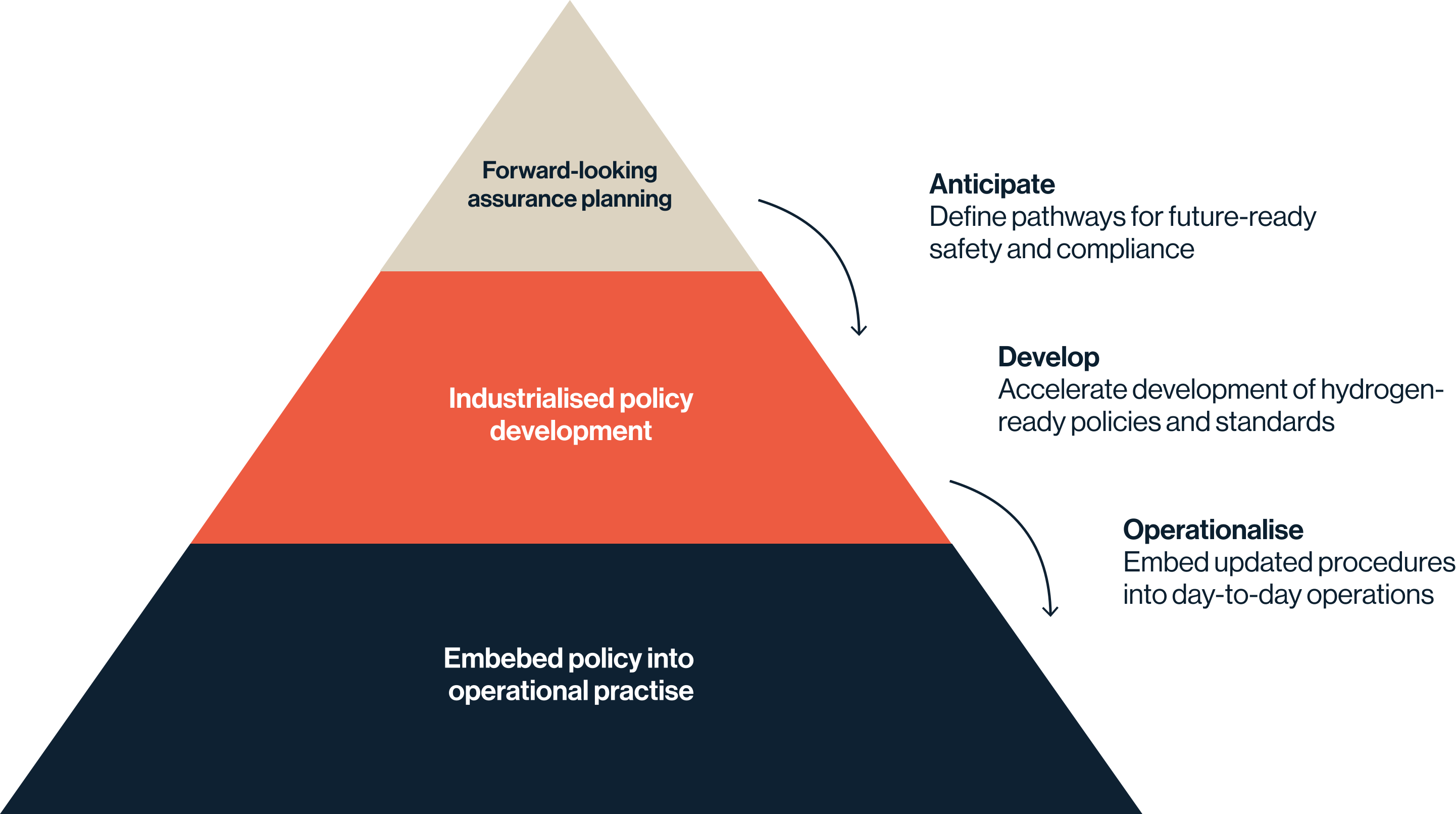
The three layers are mutually reinforcing: anticipating future requirements clarifies regulatory pathways, industrialised development accelerates policy evolution, and operational embedding ensures consistent execution across assets.
Together, these capabilities allow operators to move from technical feasibility toward operational deployment despite ongoing uncertainty.
1. Forward-looking assurance planning
Rather than waiting for regulatory clarity, operators anticipate potential operating states and map the evidence, documentation and governance changes required. This enables earlier prioritisation and more informed regulatory engagement.
In practice, this often involves scenario modelling of future network configurations, ranging from hydrogen blending to dedicated hydrogen transport corridors. Pilot projects such as the UK’s HyDeploy programme have demonstrated that blending up to around 20% hydrogen can be technically feasible in some networks without significant appliance changes. Many long-term transition strategies, however, anticipate dedicated hydrogen corridors to avoid efficiency losses associated with blending.
By identifying potential future operating states early, operators can map the technical evidence, safety cases and policy adaptations required for each scenario.
2. Industrialised policy development
Transition requires large volumes of policies and standards to evolve alongside technical evidence. Traditional approaches to policy management, often based on static documentation and periodic updates, struggle to keep pace with rapidly evolving technical and regulatory landscapes.
More systematic approaches treat policy frameworks as structured knowledge systems rather than static documents. Digital content management platforms can link engineering evidence, inspection data, regulatory interpretation and operational procedures into traceable assurance chains.
Digital technologies can further strengthen assurance systems during transition. Tools such as digital twins, real-time gas composition monitoring and predictive integrity analytics can feed operational data directly into safety cases, enabling more dynamic assurance models. AI-supported tools can also assist with evidence retrieval and policy drafting, allowing subject matter experts to focus on interpretation and regulatory engagement.
Importantly, subject matter experts retain full responsibility for interpretation, validation and regulatory engagement, ensuring governance and accountability remain intact. By shifting effort from document creation toward expert validation and interpretation, such approaches can relieve pressure on scarce technical expertise while improving traceability across assurance systems.
3. Translation into workforce practice at scale
Policies alone do not deliver safe operations. Organisations must ensure evolving requirements are understood and applied consistently across roles and assets.
In multi-molecule systems, operational margins may narrow due to differences in gas properties and system behaviour. Updated procedures must therefore be consistently interpreted by control room operators, field technicians and integrity engineers. Digital and AI-enabled approaches are increasingly being explored to support role-specific guidance, rapid training updates and traceability between technical evidence and operational practice.
Supporting National Gas through the transition
Work with National Gas illustrates how assurance capability can influence the pace of transition. National Gas owns and operates Great Britain’s National Transmission System and plays a central role in exploring how existing infrastructure could support future gases through initiatives such as Project Union and the FutureGrid programme. These programmes form part of the UK’s broader ambition to develop a hydrogen transmission backbone linking major industrial clusters.
As potential future operating scenarios were explored, National Gas needed to understand how its assurance systems would need to evolve alongside technical change. This required greater visibility of dependencies across safety cases, policies and workforce practices to support confident decision-making.
Three areas proved particularly important:
1. Developing a safety case roadmap
A central challenge was understanding what evidence and documentation would ultimately be required to demonstrate compliance in a future multi-molecule environment, particularly given uncertainty around evolving regulatory expectations.
Scenario-based analysis identified potential future operating states, assessed gaps between current arrangements and anticipated requirements, and mapped pathways toward regulatory alignment. This created a structured view of dependencies across engineering, documentation and governance activities, covering hundreds of policies and procedures across multiple assets and organisational functions within the transmission system.
The roadmap enabled earlier planning, more informed regulatory engagement, and greater internal confidence in transition sequencing.
2. Enabling AI-supported policy development
A second constraint related to the scale and complexity of policy change required. Hundreds of policies will need to evolve alongside emerging technical evidence, while subject matter expert capacity remains inherently limited.
AI-enabled approaches were tested to support evidence retrieval, synthesis, and drafting, with subject matter experts responsible for validation. Early testing indicated potential reductions of 30–40% in effort required to identify and synthesise relevant evidence, alongside approximately 30% reductions in drafting time. This allowed experts to focus more on interpretation and assurance rather than document creation.
By shifting effort from drafting toward expert review, the approach showed potential to relieve pressure on scarce expertise, accelerate alignment between evidence and operational guidance, and improve traceability across documentation.
3. Scaling workforce readiness
Transition scenarios require significant updates to training materials and operational interpretation across multiple roles, creating a substantial content development and dissemination challenge.
Work therefore explored how AI-enabled approaches could support content creation and targeted dissemination at scale, including trade-offs between in-house, external, and hybrid models. Clarifying these options identified pathways to accelerate workforce readiness while maintaining quality and governance.
Practical lessons for operators preparing for Net Zero
Together, these capabilities allow operators to move from static compliance frameworks toward adaptive assurance systems capable of supporting evolving multi-molecule networks.

Begin compliance preparation early
Regulatory ambiguity is unavoidable during transition. Early mapping of compliance variables enables proactive preparation and reduces downstream delays
Run assurance development in parallel with engineering programmes
Sequential approaches create unnecessary bottlenecks. Treating safety and compliance as a parallel workstream accelerates deployment
Treat policy as a living system
Documentation should evolve continuously rather than through infrequent large updates. Designing processes for ongoing change improves organisational resilience
Prioritise traceability
Linking technical evidence, regulatory interpretation, and operational procedures builds credibility with regulators and internal stakeholders.
Invest in dissemination, not just documentation
Workforce understanding is as critical as written policies. Scaling knowledge effectively is essential for safe operations.
Integrate digital asset intelligence into assurance models.
Tools such as digital twins, real-time gas monitoring and predictive integrity analytics can feed operational data directly into safety cases, enabling more dynamic assurance and improved infrastructure visibility.
Building the blueprint for future energy systems
The transition to a multi-molecule energy system represents one of the largest adaptations of legacy infrastructure in modern energy history. Hydrogen demand in Europe alone could reach tens of millions of tonnes per year by mid-century, according to projections from the International Energy Agency, while investment in hydrogen backbone infrastructure across the continent is estimated by the European Hydrogen Backbone initiative to reach €80–143 billion by 2040.
Its success will depend not only on technology and capital, but on the ability of operators to demonstrate safe operation as conditions evolve. In the race to Net Zero, the organisations that move fastest will not necessarily be those with the most advanced engineering, but those able to demonstrate safety before certainty arrives.
The scale of this transformation is comparable to the original development of national gas transmission systems in the twentieth century but must now be achieved within a far shorter timeframe.
Assurance capability is therefore becoming not just a compliance requirement, but a source of strategic advantage.
Janko Venhorst and Larissa Sidarto are both Strategy Execution Principals based in London.